Range of services
The entire power chain – from the incoming supply to the rack
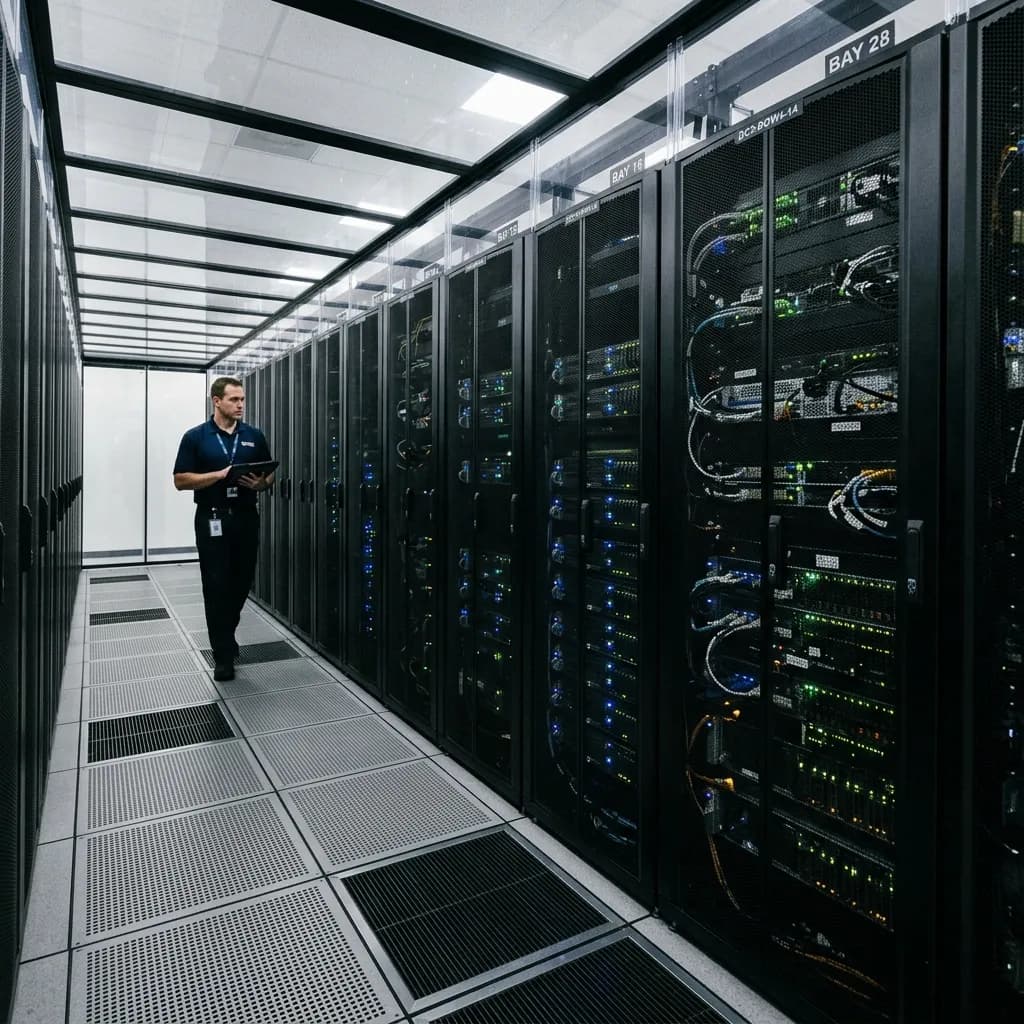
We plan and build the electrical infrastructure of data centres and server rooms: from the grid connection through the standby generator and UPS to the rack PDU, designed for N+1 or 2N. The racks sit in cold-/hot-aisle containment. Sensors for power, temperature, humidity and leaks report deviations before they turn into outages.
- Services
- Power supply, UPS & backup power · Electrical design · Monitoring & supervision · Electrical installation · New build & modernisation · 24/7 service & maintenance for customers with a service contract
- Clients
- Data centre operators, IT managers, developers, general contractors and electrical design engineers on new builds
- Design
- N+1 or 2N redundancy per stage; availability targets up to Tier IV – design of the installation, not a certification
- Records
- Load test report including transfer test, acceptance report, temperature measurement per cold aisle, alarm test, system documentation, maintenance reports
- Typical applications
- New-build data halls, server rooms in office buildings, renewal of UPS and distribution in existing facilities
Data centre service portfolio
Why Technik Partner
We conclude every phase with a load test and a written report. Maintenance, fault service and repairs – around the clock for customers with a service contract. Since 29 July 2026, Technik Partner has been part of the Circet Group, which plans, builds and maintains telecommunications and energy infrastructure across Europe.
Alterations while operations continue
We carry out new-build and modernisation projects in phases, with agreed work windows and temporary supplies for the stages that stay powered during the alterations. We conclude every phase with a load test and a written report.

Tier III and Tier IV
The Uptime Institute’s Tier classes describe the level of availability a data centre’s infrastructure is designed for. We design installations to the target you need – up to Tier IV.
Availability targets up to Tier IV describe the design of the installation. Tier certification is awarded exclusively by the Uptime Institute to a specific data centre.
- Tier III
- Installations can be maintained without having to interrupt operations. There are redundant components and multiple supply paths for critical systems.
- Tier IV
- Even higher availability. The infrastructure is fault-tolerant, so that a single fault or failure should not lead to an interruption of IT operations. Critical systems are designed with a correspondingly higher level of redundancy.
The power chain, stage by stage
Availability does not come from a single device but from the whole chain. We design these five stages to the same target.
Each stage has its own failure mode: the grid goes down, the transfer switch sticks, the battery ages, a fan stops. That is why we test not only the equipment but also the transitions between them – in a load test with a transfer test, not on the data sheet.
The level of redundancy follows the power budget. N+1 keeps one redundant unit on standby so that maintenance is possible without a shutdown; 2N runs two separate paths all the way to the rack. Which stage needs which level is decided by the availability target for the data hall.
In existing facilities, phasing comes into play as well. We install temporary supplies, work within agreed work windows and conclude every phase with a load test and a written report. That way, you can trace which part of the installation was accepted, and when.
Records are kept as the work proceeds: a load test with a transfer test for the power supply, temperature measurement per cold aisle for the containment, one triggered alarm per notification path for the monitoring. Anything not on record counts as open at acceptance.
- Grid connection
- Incoming supply, main distribution board and metering – the interface with the distribution system operator.
- Standby generator
- Generator, fuel storage and transfer switching for longer outages; test runs according to the maintenance plan.
- UPS
- Bridges seconds to minutes until the grid returns or the standby generator takes over; battery system with capacity test.
- Distribution
- Sub-distribution boards, transfer switches and circuit protection up to the rack row.
- Rack PDU
- Power strips in the rack, separated by path, with current measurement per outgoing circuit.

Talk to the team that builds your network.
Electrical engineering, data centres, fibre, IT and security – across Switzerland, under one roof.
Your contact person: Head of Data Centres